Your cake shop is busy.
Orders are coming in. Your display counter looks good. The production team is working throughout the day. Sales are increasing.
So why does the profit at the end of the month still feel disappointing?
For many bakery owners, the problem is not always low sales.
It is inventory.
A little extra cream here. Some expired ingredients there. Too much packaging material. Fruits purchased but not used. Chocolate that disappears faster than expected. Raw materials sitting in storage because they were bought in bulk.
Each individual loss may look small.
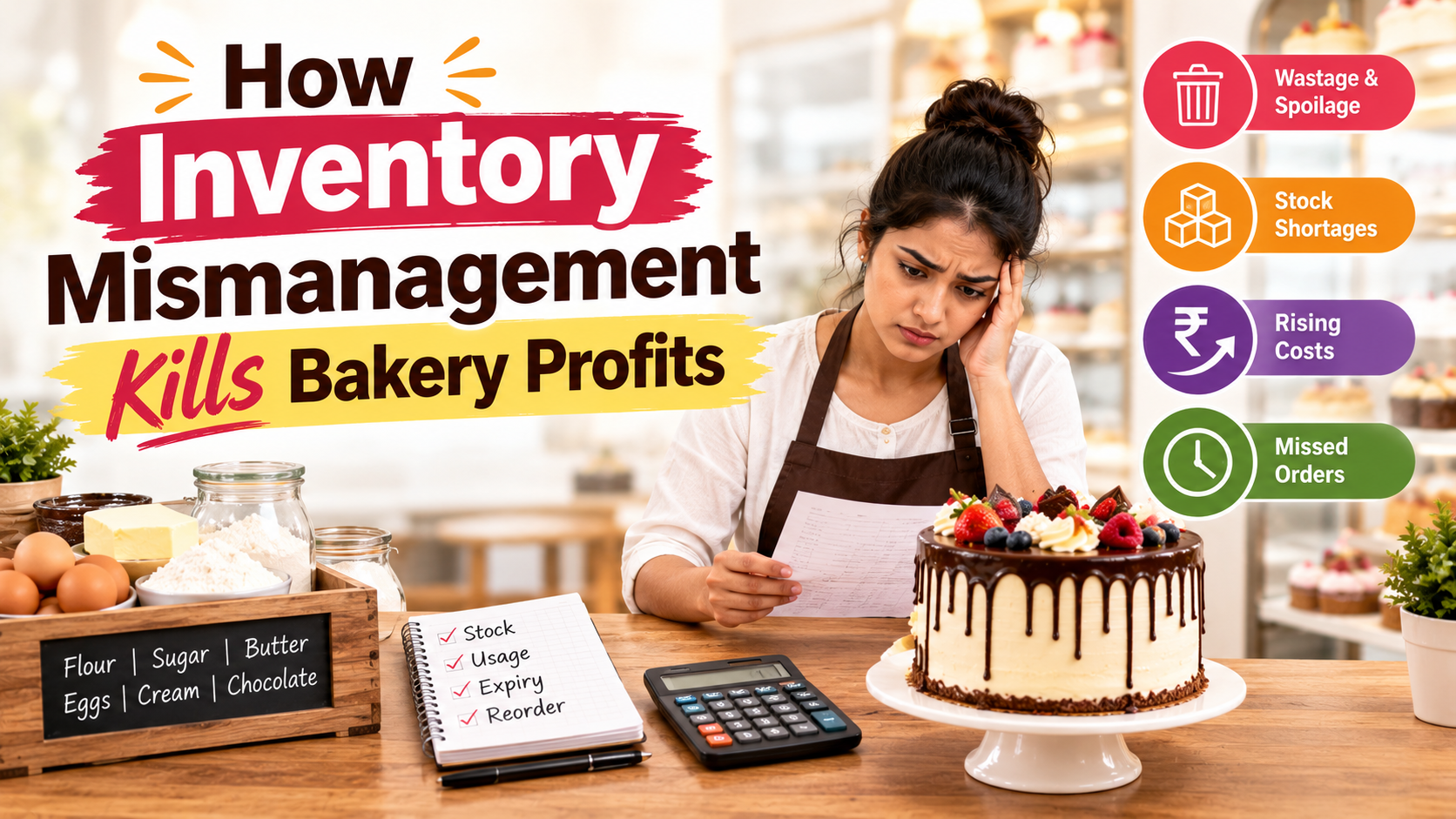
But add them together over a month, and inventory mismanagement can quietly eat into your bakery's profits.
This is why inventory management is not just a storekeeping activity.
It is a profit management activity.
What Is Inventory Mismanagement?
Inventory mismanagement happens when a bakery does not properly control what it purchases, stores, uses and wastes.
It can happen in many ways.
You purchase more ingredients than you need.
You don't know exactly how much stock is available.
Employees use ingredients without proper recording.
Products expire before they are used.
You run out of important ingredients and have to buy them urgently.
You have stock in the shop, but nobody knows where it is.
All of these problems have one thing in common.
They cost money.
1. Overstocking Locks Up Your Cash
Buying ingredients in bulk can sometimes reduce the purchase price.
But cheaper per-unit pricing does not always mean better profitability.
Imagine you purchase a large quantity of an ingredient because the supplier offers a discount.
If you use it regularly, that may make sense.
But if demand is lower than expected, the stock remains unused.
Your money is sitting inside the storeroom instead of being available for other business needs.
For a bakery, cash flow matters.
You need money for salaries, rent, utilities, suppliers, marketing, maintenance and new equipment.
Buying more inventory than you actually need can unnecessarily lock up working capital.
2. Expired Ingredients Are Direct Losses
This is one of the easiest ways inventory can affect your profits.
You buy an ingredient.
It sits in storage.
Nobody checks it regularly.
The expiry date passes.
Now you have paid for something that cannot be sold to a customer.
The problem becomes bigger when the same thing happens repeatedly with cream, dairy products, fruits, fillings or other perishable ingredients.
The solution is not simply to "buy less."
You need better visibility into what you have, how quickly it is being used and when it needs to be consumed.
3. Wastage Can Hide Inside Your Production
Not all inventory loss comes from expired products.
Some of it happens during production.
Too much cream is used.
Cake sponge is damaged.
Ingredients are measured incorrectly.
A decoration is made incorrectly and has to be discarded.
A cake is prepared but the customer cancels the order.
Small amounts of wastage may seem unavoidable.
But if you never record it, you cannot understand how much it is actually costing your business.
For example, losing a small quantity of cream every day may not look significant.
Multiply that by 30 days and then by 12 months.
Suddenly, the number looks very different.
4. Stock Theft and Unexplained Shortages
Inventory problems are not always caused by theft.
But unexplained stock shortages should never simply be ignored.
Suppose your records show that you should have 20 kg of an ingredient, but only 15 kg is physically available.
Where did the difference go?
It could be:
Incorrect purchase entry
Production wastage
Incorrect measurement
Unrecorded usage
Damaged stock
Staff error
Actual stock loss
Without proper records, you may never know.
And when you don't know where the stock is going, you cannot control the cost.
5. Running Out of Ingredients Can Also Cost You Money
Inventory mismanagement has another side.
Having too much stock is a problem.
Having too little can be just as damaging.
Imagine receiving a large cake order for the weekend and discovering that you don't have enough chocolate, cream or another essential ingredient.
Now you have to make an urgent purchase.
You may pay a higher price, spend more time arranging the material or even turn away an order.
In some cases, you may have to buy from a less preferred supplier simply because you need the ingredient immediately.
Good inventory management is therefore not about keeping maximum stock.
It is about keeping the right stock at the right time.
6. You May Be Selling Products Without Knowing Their True Cost
This is a common problem in cake businesses.
A cake may sell for ₹1,500.
The owner sees ₹1,500 in sales and feels that the order was profitable.
But how much did it actually cost to make?
You need to consider ingredients, decoration materials, packaging and other direct costs.
If ingredient usage is not tracked properly, your product costing may be based on assumptions rather than actual consumption.
This can lead to another problem.
You may be selling a popular product that generates good sales but produces a much smaller profit than expected.
Sales keep the business moving. Profit keeps the business alive.
7. Manual Inventory Records Create More Room for Errors
Many small bakeries use notebooks or Excel sheets for inventory.
There is nothing wrong with starting this way.
The problem is consistency.
Someone purchases material but forgets to update the sheet.
Another employee uses stock but does not record it.
A damaged item gets thrown away without an adjustment.
At the end of the month, the spreadsheet says one thing and the physical stock says another.
The more people involved in the process, the harder this becomes to control manually.
8. Multiple Outlets Make Inventory More Complicated
Inventory management becomes even more important when you have multiple cake shops.
Each outlet may have different sales volumes and different requirements.
One outlet may be selling a particular flavour quickly.
Another may have slow-moving stock.
One location may be running short of packaging materials while another has excess stock.
If every outlet maintains separate manual records, the owner may struggle to understand the complete picture.
Centralised inventory visibility can help management understand what is happening across locations and make better purchasing and stock decisions.
9. Poor Inventory Management Increases Food Wastage
Food wastage is not just an environmental issue.
For a bakery, it is also a financial issue.
Every ingredient that gets thrown away represents money that was spent but did not contribute to revenue.
Wastage can happen because of:
Overproduction
Poor demand forecasting
Incorrect storage
Expired ingredients
Damaged products
Incorrect portioning
Unsold products
The first step towards reducing wastage is knowing where it is happening.
If you don't measure it, you cannot improve it.
10. Your Inventory Should Match Your Sales
One of the biggest mistakes bakery owners make is purchasing based only on intuition.
"This usually sells."
"We always keep this much."
"Let's buy extra because the supplier has a good price."
Experience is valuable, but your actual sales data can make purchasing decisions much more accurate.
If you know which products sell quickly, which ingredients are consumed most and which items regularly remain unused, you can plan purchases more intelligently.
Your inventory should follow your business.
Your business should not be forced to follow your inventory.
How Can a Bakery Reduce Inventory Losses?
You don't need a complicated system to start improving inventory management.
Begin with a few basic practices.
Track Every Purchase
Record what was purchased, how much was purchased and when it was received.
Record Stock Usage
Your inventory should reduce when ingredients are consumed in production.
Monitor Expiry Dates
Pay particular attention to perishable and short-shelf-life items.
Record Wastage
Don't simply throw something away and forget about it.
Record what was wasted and, where possible, why.
Set Minimum Stock Levels
For important ingredients, decide how much stock you should maintain before placing another purchase.
Review Slow-Moving Stock
If an ingredient or packaging item is sitting unused for a long time, understand why before purchasing more.
Conduct Regular Physical Stock Checks
Digital records are useful, but physical verification is still important.
Compare what your system says with what is actually present.
How Bakery Management Software Can Help
Inventory becomes difficult when information is spread across notebooks, Excel sheets and different systems.
A bakery management system can bring inventory information into one place.
Instead of relying entirely on manual calculations, your team can maintain digital records of purchases, stock and usage.
This can make it easier to:
Know available stock
Track inventory movement
Identify low-stock items
Monitor wastage
Review purchasing patterns
Compare stock records with physical inventory
The goal is not to eliminate every inventory problem.
The goal is to give you enough visibility to identify problems before they become expensive.
A Simple Inventory Routine for Your Cake Shop
If you want to improve inventory management, start with a simple daily and weekly routine.
Every Day
Check important stock levels.
Record purchases.
Record significant wastage.
Make sure production usage is being recorded correctly.
Check ingredients required for the next day's orders.
Every Week
Review fast-moving ingredients.
Check slow-moving stock.
Look for wastage patterns.
Conduct physical stock checks for important items.
Review upcoming orders and expected inventory requirements.
Every Month
Compare purchases with sales.
Review inventory wastage.
Identify products with higher material consumption.
Check whether your stock levels are appropriate.
Review your product costing where necessary.
These simple habits can give you much better control over your inventory.
The Real Cost of Poor Inventory Management
The cost of inventory mismanagement is not limited to expired ingredients.
It can affect almost every part of your bakery.
You lose money through wastage.
You lose cash through unnecessary purchases.
You lose sales when important ingredients are unavailable.
You spend staff time checking and correcting records.
You may price products incorrectly because you don't know their actual cost.
And most importantly, you may not realise how much money is being lost.
That is what makes inventory problems dangerous.
They are often small enough to ignore but frequent enough to become expensive.
Final Thoughts
A busy bakery does not automatically mean a profitable bakery.
You can increase sales every month and still struggle to improve your bottom line if inventory is not under control.
The answer is not simply to purchase less.
It is to purchase smarter, store better, monitor usage, reduce wastage and understand where your money is going.
Good inventory management means knowing what you have, what you need and what is being wasted.
Once you have that visibility, you can make better purchasing decisions, improve product costing and protect your bakery's profits.
Ready to Take Control of Your Bakery Inventory?
CakePro helps cake shops and bakeries manage important operations from one platform, including orders, billing, inventory and customer management.
Instead of managing inventory and other bakery operations through separate notebooks and spreadsheets, CakePro gives your team a more organised way to manage daily business information.
Want to see how CakePro can help your bakery manage its operations more efficiently?