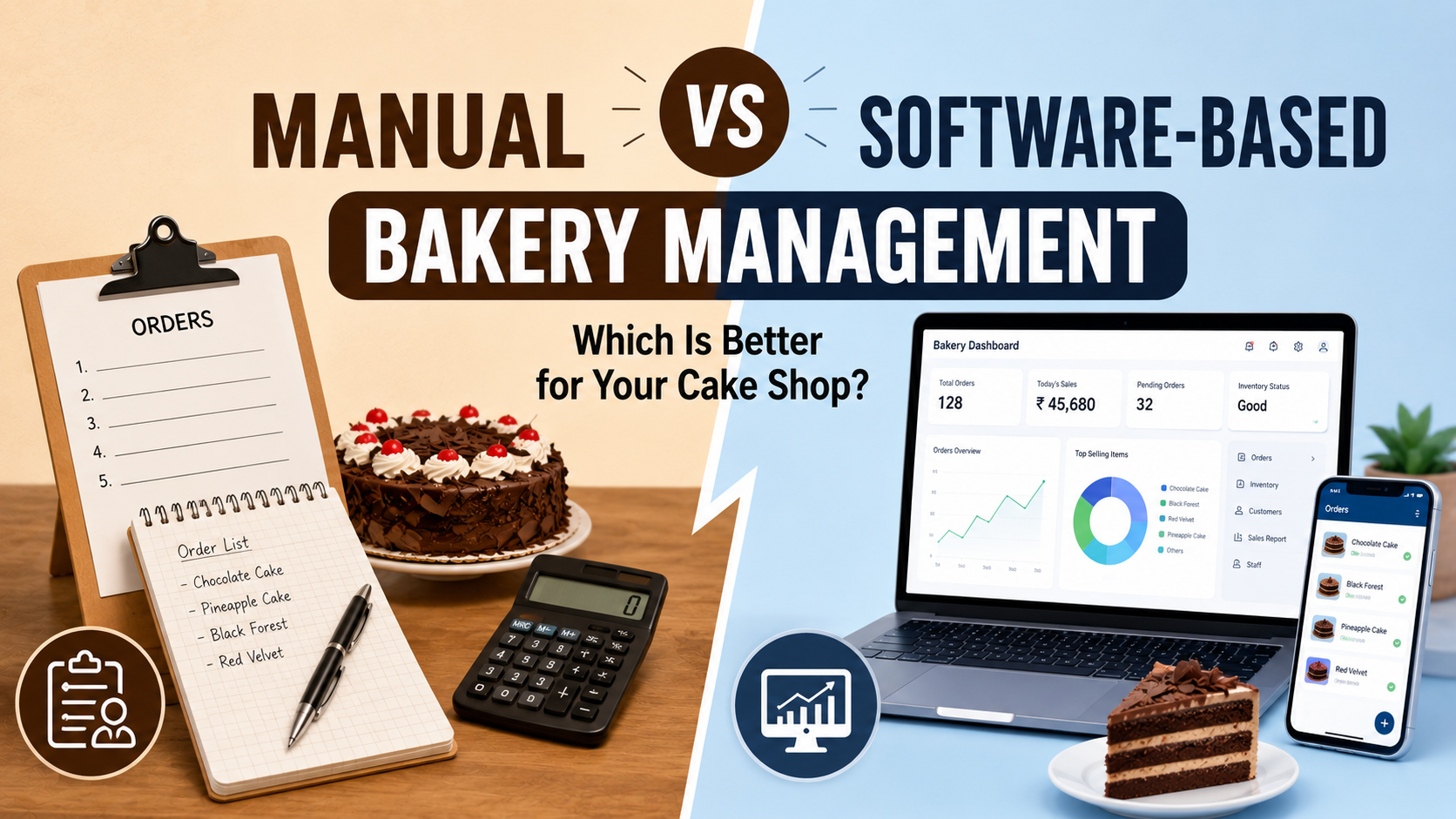
Running a cake shop is very different when you have 10 orders a week compared with 50 or 100 orders a day.
In the beginning, a notebook may be enough to record orders. An Excel sheet may be enough to track inventory. You may even remember most of your regular customers by name.
Then the business starts growing.
Orders start coming through WhatsApp. Someone takes an order over the phone. A customer walks into the shop. Another order comes through Instagram. Your staff updates one register while you are checking another.
Suddenly, managing the bakery becomes almost as difficult as running it.
This is where many cake shop owners start asking an important question:
Should I continue managing my bakery manually, or should I move to bakery management software?
There is no single answer for every bakery. But understanding the difference can help you decide what makes sense for your business.
What Does Manual Bakery Management Mean?
Manual bakery management usually means using notebooks, registers, Excel or Google Sheets, WhatsApp messages and separate billing systems to manage different parts of the business.
For a small bakery with limited orders, this can work reasonably well.
You may have one notebook for advance orders, another sheet for inventory, a billing application for invoices and WhatsApp for customer communication.
The problem starts when the number of orders, employees and products increases.
More business means more information to manage.
And more information means more chances of something being missed.
Why Manual Management Feels Easy in the Beginning
There is a reason many bakery owners prefer manual systems initially.
They are familiar.
You don't need training. You don't need to learn new software. You can write down an order in seconds and continue working.
For a small home baker or a newly opened cake shop with a handful of orders, a notebook can be perfectly practical.
But there is an important difference between something being simple and something being scalable.
A system that works for 20 orders may not work for 200.
1. Order Management Becomes Difficult
Imagine receiving 30 custom cake orders for the weekend.
Each order has a different flavour, weight, design, message, pickup time and payment status.
Now imagine recording all of this manually.
Someone has written an order in a notebook.
Another order is in WhatsApp.
A third order is in an Excel sheet.
The baker has received instructions verbally.
This is where mistakes happen.
A wrong flavour or missed delivery time can turn a profitable order into an unhappy customer.
How software helps
Bakery management software allows order information to be stored in one place.
Your team can see what needs to be prepared, when it needs to be ready and what the customer has requested.
Instead of searching through messages, staff can work from a structured order record.
2. Inventory Is Harder to Track Manually
Inventory is one of the biggest challenges in any bakery.
You need to know how much cream, chocolate, flour, butter, fruits, fillings, packaging material and other ingredients are available.
With manual tracking, stock records depend heavily on staff entering information correctly every time.
Miss one update and your stock figure may no longer be accurate.
How software helps
A bakery management system can provide better visibility into stock movement.
You can monitor purchases, consumption and available inventory and identify products that need attention.
This becomes particularly useful during weekends, festivals and other high-demand periods.
3. Manual Billing Takes More Time as Orders Grow
When your bakery is small, preparing bills manually may not seem like a problem.
But as transactions increase, billing becomes more complicated.
You may have:
- Cash payments.
- UPI payments.
- Advance payments.
- Balance payments.
- Discounts.
- Cancellations.
- Different types of orders.
Keeping everything accurate becomes difficult when records are maintained across different places.
How software helps
Integrated billing makes it easier to maintain consistent transaction records and generate reports.
It also reduces repetitive data entry and makes it easier to review sales at the end of the day.
For businesses that are required to comply with GST, accurate billing and record keeping are especially important.
4. Finding Customer Information Becomes Difficult
A customer ordered a chocolate truffle cake six months ago.
Now they are calling again for another birthday.
Can you quickly find out what they ordered last time?
If customer information is stored only in WhatsApp conversations or paper bills, the answer may be no.
This means you are losing valuable information that could help you build repeat business.
How software helps
A customer management system can maintain customer details and purchase history in one place.
This can help your team understand customer preferences and provide a more personalised experience.
It can also support marketing activities such as birthday reminders and relevant promotional campaigns.
5. Reports Take Too Much Time
This is where the difference between manual and software-based management becomes very noticeable.
Suppose you want to know:
- Which cakes sold the most last month?
- How much did we sell this week?
- Which products are performing poorly?
- How many orders are pending?
- How much inventory was used?
- How many customers are repeat customers?
With manual records, answering these questions may require checking multiple notebooks and spreadsheets.
Sometimes the information may not even be available.
Software changes this
Reports can be generated much faster when your business data is already stored digitally.
Instead of spending hours preparing reports, you can spend that time understanding the numbers and deciding what to do next.
6. Managing Multiple Cake Shop Locations Is a Different Challenge
A single-location bakery can sometimes survive with manual processes.
But imagine you have three or five outlets.
Each location has its own:
- Orders
- Inventory
- Staff
- Sales
- Customers
- Expenses
- Daily transactions
Managing this through separate notebooks and spreadsheets can become extremely difficult.
Why software becomes important
Multi-outlet businesses need centralised visibility.
The owner should be able to understand what is happening across locations without calling every store manager individually.
This is one of the strongest reasons growing bakery businesses move towards dedicated management software.
7. Human Errors Become Expensive
Manual systems depend on people.
People make mistakes.
An employee may enter the wrong quantity.
A payment may not be updated.
An order may be written for the wrong date.
A stock adjustment may be forgotten.
One mistake may not seem serious.
But when hundreds of transactions are happening every month, small errors can become expensive.
Software cannot eliminate every human error, but it can reduce repetitive manual work and create more structured processes.
8. Manual Systems Make It Difficult to Scale
This is perhaps the biggest issue.
A bakery can manage manually for a certain period.
But eventually, the owner starts becoming the central point for everything.
Staff call the owner for order details.
The owner checks inventory.
The owner handles customer complaints.
The owner reviews billing.
The owner checks sales.
The owner solves operational problems.
Instead of building the business, the owner becomes the system.
That is not sustainable.
Software helps create independence
A good bakery management system gives employees access to the information they need while giving the owner visibility into the business.
This allows the owner to delegate more effectively and focus on growth.
So, Is Manual Management Always Bad?
Not at all.
If you are a home baker with a small number of orders, manual management may be completely sufficient.
If your business has:
- Few orders
- Limited inventory
- One or two people
- One location
- Simple billing requirements
there may be no urgent need for sophisticated software.
The important thing is to recognise when your existing system is becoming a limitation.
When Should a Bakery Move to Software?
There is no magic number of orders that tells you when to switch.
However, consider moving to bakery management software when you start experiencing problems such as:
- Missed or incorrect orders
- Difficulty tracking advance payments
- Frequent inventory shortages
- High wastage
- Time-consuming billing
- Difficulty preparing reports
- Increasing staff dependency
- Multiple sales channels
- Multiple outlets
- Difficulty maintaining customer records
If you are spending several hours every week simply searching for information, that is often a sign that your systems need an upgrade.
What Should You Look for in Bakery Management Software?
Don't choose software simply because it has a long list of features.
Choose something that solves your actual problems.
For a cake shop, useful features may include:
Order Management
The ability to manage advance orders, custom cake details, pickup and delivery schedules and payment status.
Inventory Management
A simple way to track ingredients, stock movement and wastage.
Billing
Fast and accurate billing with appropriate tax and invoice support.
Customer Management
Customer details, order history and tools to support repeat business.
Reports
Clear information about sales, products, customers and business performance.
Multi-Outlet Management
Useful if you operate more than one cake shop or plan to expand.
Most importantly, the software should be easy enough for your staff to use every day.
A powerful system that your team doesn't actually use is not a useful system.
Manual vs Software: What Should You Choose?
Think of it this way.
Manual management helps you start.
Software-based management helps you scale.
You don't need sophisticated technology simply because everyone else is using it.
But if your bakery is growing and manual processes are creating missed orders, inventory problems, billing headaches or unnecessary work, continuing with the old system may actually cost you more.
The right software should save time, reduce errors and give you better control over your business.
Final Thoughts
There is nothing wrong with starting a bakery using a notebook or spreadsheet.
In fact, many successful cake shops started exactly that way.
The problem is continuing with those systems long after the business has outgrown them.
As your bakery gets more customers, more products, more employees and possibly more locations, the amount of information you need to manage increases rapidly.
At that stage, having the right technology is no longer just about convenience.
It becomes part of running the business efficiently.
The goal isn't to replace the way you run your bakery. The goal is to make running it easier.
Ready to Move Beyond Manual Bakery Management?
If your cake shop is growing and managing orders, inventory, billing and customers is becoming difficult, CakePro can help.
CakePro is an all-in-one cake shop and bakery management app designed to help Indian bakeries manage their daily operations from one platform.
Want to see how it works for your bakery?